
Bamboo - nature's warrior against climate change
The key to a sustainable future
The world is at a crossroads in relation to climate change. It is clear that humans do not have the capability to go back and rectify the effects of excessive wood consumption and the sharp increase in greenhouse gas emissions. As temperatures rise and extreme weather events become more common, an increasing number of people become vulnerable to devastating impacts.
According to the report of the United Nations Intergovernmental Panel on Climate Change (IPCC), our goal by 2030 is to restrict global warming to a maximum of 1.5 degrees Celsius compared to pre-industrial levels. Exceeding this limit would lead to increasingly severe climate-related catastrophes, surpassing our ability to adapt. The essential elements of the Earth’s system would undergo profound and irreversible changes. Consequently, heatwaves, food shortages, and the spread of infectious diseases could potentially result in millions of casualties by the close of this century.
The most effective way to avert climate-induced destruction and desolation is to embrace sustainable approaches that maintain low greenhouse gas emissions, stabilize temperatures, and alleviate extreme weather conditions.
Extremely effective Carbon "sink"
- Through forests, bamboo acts as an extremely effective giant carbon sink
- Through sustainable products from bamboo, it helps store carbon for a long time and can be used as a substitute for other materials such as steel, concrete, and aged wood.
The secret to success here is because bamboo belongs to the grass family (Poaceae), not a tree. That’s why bamboo has an extremely fast growth rate and biomass increase. The project’s bamboo variety (Dendrocalamus asper.) can grow 3 – 10 cm per day, reaching a height of 15-20 m with a diameter of 8-15cm after 4 to 5 years.
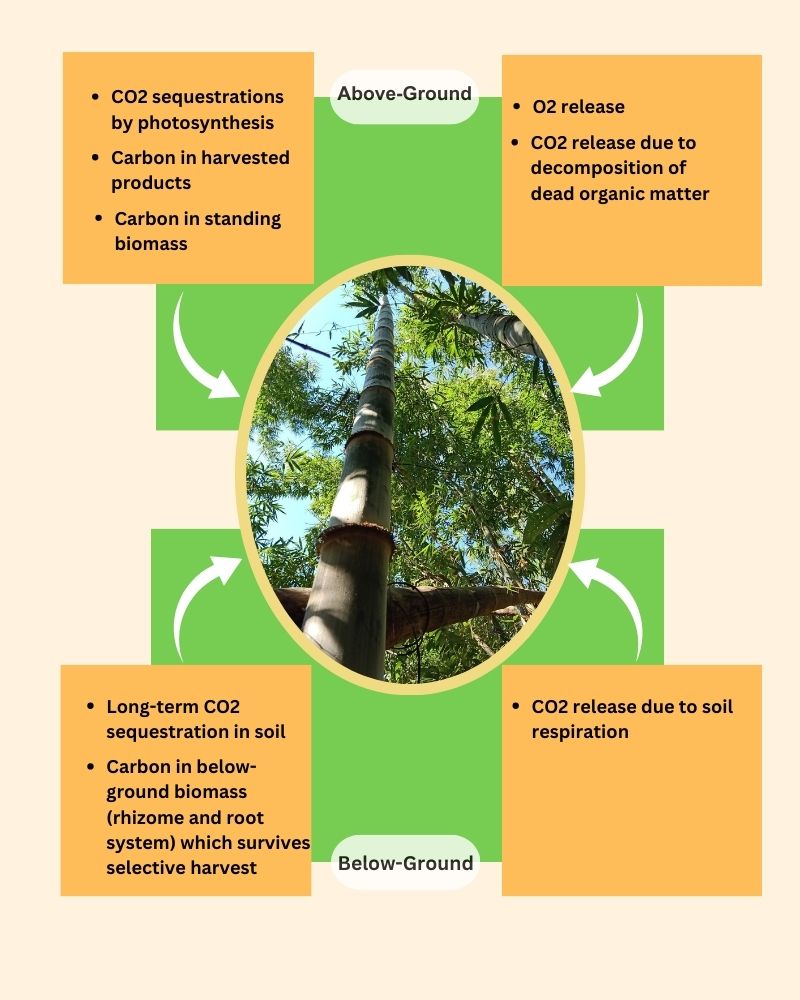
Thanks to its fast growth rate, bamboo has the ability to sequester carbon in its biomass. According to estimates, one hectare of effectively planted and managed Dendrocalamus Asper bamboo forest has the ability to sequester over 300 tons of CO2/ha/year (estimated for harvested wood only). Bamboo effectively absorbs not only above-ground carbon (AGC) but also below-ground carbon (BGC) in the root system; to a lesser extent, bamboo also absorbs soil organic carbon (SOC).
Numerous studies and evaluations indicate that Bamboo has the capacity to sequester four to five times the amount of carbon compared to perennial tropical wood species, all while generating 30% to 50% more oxygen. This underscores Bamboo’s efficacy as a valuable means of lowering greenhouse gas levels.
Replacing fossil fuels and reduce deforestation
Bamboo helps avoid the use of fossil fuels and reduces deforestation by providing an alternative, highly renewable source of biomass energy.
Bamboo can provide a sustainable source of bioenergy for many people who rely on solid biomass for cooking, such as charcoal or briquettes. It can also be converted into gas or pellets to provide power and heating,
While 60 – 70% of mature bamboo culms can be used to create value-added products such as handicrafts, furniture, etc. Bamboo by-products become a valuable source of energy. Bamboo has some essential fuel properties, such as low ash content and low surface moisture. The calorific value of bamboo is higher than most identified fuel woods and is close to that of commonly used rubber wood. Through pyrolysis, up to 50% of the carbon from bamboo tissue can be transferred to biochar (organic fertilizer), with the remaining 50% being used to produce energy and fuel. Bamboo charcoal is a type of manufactured biochar, an abundant by-product of the bamboo processing industry.


Because it regrows quickly and matures faster than most trees, bamboo can help reduce pressure on other forest resources, reducing deforestation. Bamboo charcoal and gas have similar calorific values to commonly used forms of bioenergy: a community of 250 households only needs 180 kg of dry bamboo to generate enough electricity for six hours.
Within regions in for instance Europe, bamboo can be transformed into pellets to produce energy and provide heating, serving as an eco-friendly biomass source and contributing to renewable energy targets. The advantage of bamboo is that it can thrive in arid areas, eliminating the need to vie for agricultural land.
A solution for substituting traditional construction material
The construction industry is one of the largest contributors to carbon emissions and environmental degradation. However, bamboo offers a sustainable alternative to traditional construction materials such as concrete and steel. The strength, durability and flexibility of bamboo make it an ideal material for construction purposes. Bamboo can be used to build homes, furniture, and even large-scale infrastructure projects.
Along with carbon storage, using bamboo to replace traditional materials will “lock” carbon during use. Research carried out on European industrial bamboo products, such as panels, floors and beams, has shown that the carbon emissions of these products are low or even negative throughout their life cycle, outperforms Forest Stewardship Council-certified hardwoods and can be used as an alternative to steel and cement.
Bamboo grows quickly and requires minimal resources to cultivate, making it a renewable and environmentally friendly option. Furthermore, building with bamboo can be cost-effective, especially in developing countries where resources are scarce. By using bamboo as a building material, we can reduce our dependence on carbon-intensive materials, reduce waste, and create sustainable and resilient structures.
Present utilization of forest resources must be balanced with the objective of minimizing the adverse effects on the forest ecosystem. This is where the utilization of natural resources like bamboo can offer significant advantages for both humanity and the environment.

Soil erosion prevention solution
Soil erosion due to deforestation and improper exploitation of forest products is an urgent environmental problem with far-reaching consequences. However, bamboo is the key to solving these challenges. With its extensive root system, bamboo helps stabilize soil and prevent erosion and landslides. By promoting bamboo planting in vulnerable areas, we can protect valuable topsoil, enhance biodiversity and restore degraded lands, creating an ecosystem more resilient.
With a fast biomass rate, a huge root and rhizome network, the root system growing in the surface layer of the soil (20 – 60 cm deep) can reach 100 km per hectare, the rhizome can survive more than a century, allowing bamboo to regenerate even when the trunk is cut down or destroyed in a fire or storm. Bamboo roots are especially useful for binding topsoil and preventing erosion of slopes, river banks, degraded soils or controlling areas frequently affected by landslides.

Bamboo leaves also play an important role in preventing the effects of rain because they help disperse large raindrops into smaller ones. This contributes to the even distribution of groundwater throughout the forest area and thus significantly reduces the risk of runoff and erosion on slopes or hillsides.
Bamboo provides the soil with a lot of organic matter. The large quantity of dry leaves, branches and stems of bamboo helps circulate nutrients, thereby maintaining soil fertility physically and chemically. The soil becomes more porous with better permeability. As a result, ecological functions such as water regulation and nutrient recycling were restored.
Because bamboo can grow on dry land, it can also be used to help restore land areas degraded by industrial use or mining. One of the wonderful properties of bamboo is its ability to absorb and filter excess nutrients and fertilizers
Raise Groundwater
Bamboo forests protect rivers and ecosystems by regulating water quantity and quality. Bamboo forms a wall that controls sediment and prevents loss of flow in the river.
The extensive root system and bamboo forest cover prevent stream evaporation and can increase the water table within a few years. Research has shown how severely degraded land was restored after bamboo planting: within 20 years, the water table rose by 10 meters, which could bring agricultural crops and tree species Intercrop with bamboo.
Bamboo acts as a reservoir by collecting and storing large amounts of water in the roots and stems during the rainy season and returning the water to the soil, rivers and streams during droughts. Bamboo’s extraordinary ability to hold and control large amounts of water makes it a plant that can help reduce land desertification.

